Tuesday, July 9, 2013
Hiatus
Well, I can see that I haven't exactly been on pace for my weight goal. However, I am taking an 18 month hiatus from this goal. Don't worry, I'll still be reading, but my book selection will be rather slim and my access to the internet extremely limited. Come January 2015, I'll be able to pick things up right where I left off! (though I'll probably just start over with the new year)

The Elegant Universe by Brian Greene
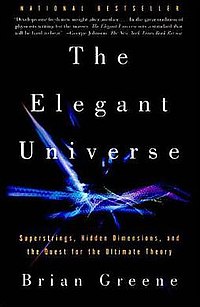
Title: The Elegant Universe: Superstrings, Hidden Dimmensions, and the Quest for the Ultimate Theory
Author: Brian Greene
Genre: Science
Length: 464 Pages
Weight: 1.6 lbs
Date of Completion: June 17, 2013
Thoughts:
I know that it is easy to complain about how unsciency a book about an extremely difficult physics topic that is meant for the general public can be. There aren't any equations; the most we get are some general inverse relationships implied at one point. The author and publisher assume that the individuals who read this book wouldn't be able to follow the equations, and they would detract from the "telling of the story". Ironically, this is ridiculously true for a book on string theory. At one point, the author finally acknowledges that the actual equations haven't ever been solved, just approximated. To the uninformed public, that sounds really, really bad to be basing a theory off of a bunch of equations you can't solve. For those who understand perturbation theory, it is a godsend in physics. However, the lack of an actual solution does present a problem.
While I realize that there are intelligent people who would be interested in the book who are not physicists and do not have an adequate math background to keep up with a rigorous derivation of the theory, I honestly imagine them still having a difficult time with the book. Only with my background of a physics degree helped make sense of things. Greene talks like a physicist: intelligent, with a large vocabulary, and completely aware that you are very stupid and he is dumbing down very complex and complicated ideas so you can try to understand it. I've had many conversations with professors that are just like it in the past.
However, Greene is a very talented writer. His excitement for the topic jumps off the page and helps carry you through some rough spots where he skates over some iffy explanations. Overall, it was a book that I enjoyed reading. Though it had the usual general physics introduction in the first 1/4 of the book (that gets old really fast when you have read the same basic intro in every book like this you read), the progression through the theory was smooth. He addressed the major topics, who developed them and why they came about, what they mean in physics, and what they mean to the rest of the world. For the purposes of the book, he did an excellent job.
Years ago, I watched the NOVA miniseries Greene did for a science class. I now own the DVD for the program and have watched it for fun. I got the book a few years ago because I like the topic and the way Greene presents relativity. Personally, I am very glad I waited until I had finished college (especially quantum statistical mechanics) before reading the book. It helped with my comprehension immensely.
Tuesday, June 18, 2013
Abhorsen Trilogy by Garth Nix

Title: Sabriel
Author: Garth Nix
Genre: Fiction/Fantasy
Length: 336 Pages
Weight: 0.7 lbs
Date of Completion: June 10, 2013

Title: Lirael
Author: Garth Nix
Genre: Fiction/Fantasy
Length: 371 Pages
Weight: 0.8 lbs
Date of Completion: June 12, 2013

Title: Abhorsen
Author: Garth Nix
Genre: Fiction/Fantasy
Length: 720 Pages
Weight: 0.8 lbs
Date of Completion: June 15, 2013
Thoughts:
This trilogy is one of my all time favorites! No matter how many times I have read them, I always find myself being pulled back into Nix's world. I find it particularly unusual because for a book about necromancy (raising the dead), it is not evil or necessarily horror-creepy. It deals with dark themes and imagery surrounding death, and consequently falls under the title of dark fantasy. So while the books may be a little dark and creepy, they are immensely well-written. In addition, they are very, very British.
Nix's world is a mixture of a Tolkien-esque fantasy land separated from a modern world set in WWII England by a single wall. Although the author is Australian, there are more than enough gentle touches of British culture and humor to really hit the spot. Additionally, it is amazing to get such an amazingly in-depth back story to the culture of the novels without it getting dry or overbearing. Nix is the Tolkien of dark fantasy. (Don't worry, I will continue with the LOTR theme for the whole post. But in all honesty, I think the story is nearly on par with anything Tolkien has done.)
The imagery and geography of Death is absolutely captivating, as is the intriguing nature of the necromancer's bells. It carries hints of Grecian mythology with the river of death that pulls spirits to their final resting place through a series of gates, but is uniquely presented. With that, as you find out more as the trilogy progresses, the magic and history of the Charter and the bells is impressive. I think these two pieces of the story are what set these books apart for me.
Sabriel is one of the best heroine's in fantasy that I have ever read. She is neither a damsel-in-distress nor a warrior woman, but a young woman who thinks and acts precisely the way an 18-year-old (granted a fairly mature one) would in her position. Sabriel is not strung up in a hero complex, and she doesn't lack in heart or humanity-she gets angry, jealous, frustrated, loves deeply, and gets revenge, yet she retains the pure quality of opposing the evil that has invaded her Kingdom. It is almost a relief to meet a character with such basic reasons. Strong, intriguing, and remarkably handy with a sword, Sabriel is my favorite main hero of the whole trilogy, though she only stars in the first novel.
In the second and third books (Lirael and Abhorsen, respectively), you get a continuation of the unique, dark blend of humor and horror, but the stakes are much higher. Like LOTR, this story is about the Armageddon and the end of the world-both in the Old Kingdom and Ancelstierre. Evil is more dangerous and abundant, the magic is more complex, and the entire story begins to take on larger dimensions Diving into themes of order vs chaos, and even the different kinds of order, it even approaches a metaphysical discussion of freedom. The struggles of the protagonists raise many philosophical questions: Is genuine freedom to be unbound? Is mastery the only form of power? Is order better than chaos?
My only real criticism is a desire for more. Nearly everything was tidied up nicely at the end of Abhorsen, but Nix clearly has more stories about this world, as it is continued in Across the Wall. The Disreputable Dog hints (I think) at a future relationship of Nick and Lirael, which I would find fascinating. He has so many problems with all of the Free Magic and Charter Magic warring in him now, not to mention he is is still an Ancelstirrian who knows very little about the Old Kingdom. On the other hand you have Lirael, who has no experience with men (or boys) and is the Abhorsen-in-Waiting. I'm just waiting for Nix to continue on in this world and give them another story.
Neverwhere by Neil Gaiman

Title: Neverwhere
Author: Neil Gaiman
Genre: Fiction/Fantasy
Length: 400 Pages
Weight: 0.4 lbs
Date of Completion: June 6, 2013
Thoughts:
And I'm back to Neil Gaiman. Although this was already in the stack of books I wanted to read next, the thing that pulled this one to the top is thanks to, again, my British obsession. Rewind back to March, and BBC4 radio announces that a radio drama adaptation of Gaiman's work would be released in a series of 6 segments. Only for a limited time could you listen online (which is crucial to those of us who can't listen live in the USA. Although you can online, prime radio hours in the UK usually coincide with school/work over here) and I only got through the first episode. However, through some creative searching, I found a site that let me complete the series not to long ago.
With the talents of James McAvoy, Natalie Dormer, David Harewood, Anthony Head, Christopher Lee, Benedict Cumberbatch, and even author Neil Gaiman bringing London Below to life, it is safe to say that the result is absolutely stellar. I really wish America had the culture and audience to be able to do something like this here. Mind you, I don't hate the idea of having to move to London to get that. At any rate, hearing this story so incredibly dramatized on the radio really brought me back to the novel.
For some, the actors voices were strong in my head, but I found that this enriched the reading experience rather than detracted from it. Whenever Richard spoke, I could here James McAvoy's lovely Scottish lilt in the words. And I rest my case for reading Islington; hearing the twistedly angelic voice of Benedict Cumberbatch is enough to make anything better. When I was in London this time last year (has it really been a year already?) I was excited to see the tube for myself and see how the picture in my head compared to what it really looks like. Now I'm hooked on the UK; I'm desperate to get back! Looks like I'm planning a trip for the summer of 2015 to go to London.
Sunday, June 16, 2013
Crossed by Ally Condie

Title: Crossed
Author: Ally Condie
Genre: Fiction/Fantasy
Length: 400 Pages
Weight: 1.0 lbs
Date of Completion: June 6, 2013
Thoughts:
Dystopic YA fantasy. It really seems to be the thing these days. I stumbled across an article last week (that I can't find ANYWHERE) that talked about how labeling books as YA is incorrect. I'm not always sure if I fall under the category of "young adult" anymore (the alternative is "old adult"?), but I am a big fan of many books in that classification. Trues, the main characters are teenagers, dealing with teenage problems. But the worlds and stories are not less appealing because I am no longer a teen.
For Condie, I was intrigued by the world she created in Matched, and I was ready to dive into the sequel. In all honesty, it was a very easy read and took me less than a day to finish. Absolutely NOTHING happens. Given the power that YA fiction has come forth with recently, I was more than a little disappointed with this middle book to the trilogy. I know that a second story is always the hardest: you have already captured some amount of interest by having to introduce the characters and their reality, as well as set up the main conflicts in the first book. However, you can't get into the real action and resolution/twists until the finale in the third book. This leaves you with a difficult task of all the "stuff" in the middle. I've often wondered if, when there isn't necessarily enough material to have a full story arc separated correctly for three books, why authors don't just leave it at two books. If feel like this would have been a good idea for this story.
Critique aside, I did like the very beginning of the book. The first "chapter" for both Cassia and Ky had humanistic insight that hints at a some real talent in Condie. For example,
"And it is strange that absence can feel like presence. A missing so complete that if it were to go away, I would turn around, stunned, to see that the room in empty after all, when before it at least had something, if not him." (pg 6)
"I don't know why it's not the same, but it isn't. At first, I thought it was having the picture that made it special, but it's not even that. It's looking at something without being watched, without being told how to see. That's what the picture has given us." (pg 12)
The two poems, Do Not Go Gentle Into That Good Night by Dylan Thomas and Crossing the Bar by Alfred Lord Tennyson, are beautiful. Tennyson is one of my absolute favorites poets of all time! I like their inclusion, and I think it gives the teenage audience a new appreciation for the culture (and lack of) that mankind has developed and, subsequently lost. This speaks a lot about what art means in relation to being human. And every time I think about this, I am drawn back to a speech from Amanda Palmer (yup, I follow her on Twitter) you can read here. I'm not an artist, at least not in how I can create things, but I can understand the connections and the beauty. It's all a bout being human. This is a concept (losing art and culture) that is present in nearly all dystopia novels, and I think that says a lot about the individual and expression we stand to lose.
Irish Fairy and Folk Tales by W.B. Yeats

Title: Irish Fairy and Folk Tales
Author: W.B. Yeats
Genre: Fiction
Length: 416 Pages
Weight: 1.8 lbs
Date of Completion: June 1, 2013
Thoughts:
I've always had a thing for Ireland. When I was much younger, I got obsessed with all the Celtic knot work-in jewelry, stitching, and even architecture. The entire culture was ancient and fascinating. This was all a part of a larger love I have for the UK. Very specific to Ireland, though, was my desire to go live there. I dreamed that I might go and work at a pub or local library in a small town. I'd go and write in the old fashioned stone manor of under the trees outside of a castle. This was also during a time when I went through a major writing phase; I was working on a story with the working title of "Irish Cinderella". Obviously, it was a retelling of the classic fairy tale in Ireland, and I had put a lot of effort into researching the history and culture.
I've mentioned before how much I fairy tales in all forms. These ones specific to the Irish culture have a special place in my heart. Similar to those in the Mabinogion, they are stylized to the historical Irish-meaning that they bear no resemblance to anything Disney would produce. Some of the stories are moralizing, others are more closely related to the ramblings of hysterics. They are all distinctly Irish, starring ghosts, mermaids, leprechauns, fairies, and all kinds of fantastical creatures. A particular favorite story was about Red Caps, an Irish sort of bog monster. For those who don't catch the immediate reference, Red Caps are also found in the magical world of Harry Potter (most notably in book 3). Gotta give J.K. huge props for her incredible insight into creature and legend accuracy.
Yeats, while best known for his poetry, studied legends and the occult which led to the majority of his literary work in Irish folklore. His poetry is very different from, say, Tennyson, but in the context of his interests, fits very well with the lore. There were only a few of his own tales in the collection of stories, most came from others he was in contact with. He recorded local legends and newspaper clippings of stories, along with long-told classics. It makes for an eclectic collection, but it is enchanting to read. I desperately want to move to Dublin now!
This book did take me quite a while to read. Besides it's length, many of the stories are written in Irish brogue. As an American, it was fun to hear the accent in my head, but it occasionally made for slow reading. I kept this book on my nightstand to read a short story or two before bed. Although I started this book nearly a year ago, I am going to include it in this year's reading list.
Tuesday, June 4, 2013
52 Things to Help Me Be a Better Person
I've been really busy lately. The older I get, the more there seems to be that I need to do. It is so easy to become overwhelmed, bored/busy, and have no idea how or where to start. At work, it is easy for me to sit at the computer and make a list of all the things I need to do, and slowly work on them. When it comes to the rest of my life, I can't seem to get either side to function well; I don't remember to make lists, and if I do make a list, I never get things done.
While I was sitting at work, I was struck with the thought that I could make weekly task lists for life, just like I do for my job. I found this article and this article that talk about the power of weekly goals. My brain barreled on further, and I decided that I could use this concept to better myself, not just get things done. By adding one small self-improvement task to a weekly list, I could work on changing myself into an overall better person. There are so many things that you can see you want to do: spend more time with your family, be more spiritual, eat healthier, do service. Finding time and space to fit all of these things in can be stressful.
Instead, I have made a list of 52 Things to Help Me Be a Better Person, one for each week. It is divided up into five sections: personal goals, spiritual goals, service goals, intellectual goals, and health goals.
Personal
Intellectual
While I was sitting at work, I was struck with the thought that I could make weekly task lists for life, just like I do for my job. I found this article and this article that talk about the power of weekly goals. My brain barreled on further, and I decided that I could use this concept to better myself, not just get things done. By adding one small self-improvement task to a weekly list, I could work on changing myself into an overall better person. There are so many things that you can see you want to do: spend more time with your family, be more spiritual, eat healthier, do service. Finding time and space to fit all of these things in can be stressful.
Instead, I have made a list of 52 Things to Help Me Be a Better Person, one for each week. It is divided up into five sections: personal goals, spiritual goals, service goals, intellectual goals, and health goals.
Personal
- Send 5 "thank you" cards
- Send 5 "thinking of you" cards
- Pick something off of your bucket list and plan it
- Repeat a list of daily affirmations every morning
- Make a list of all your positive attributes and things you like about yourself
- Plan and go on a date
- Get rid of one item of clothing
- Get rid of one pair of shoes
- Write 3 things daily in a gratitude journal
- Write in your journal every day
- Catalog the week with pictures
- Write and send 3 letters
- Learn a new piano song
- Learn a new guitar song
- Deep clean and organize bedroom
- Make a list of bad habits and pick one to work on stopping
- Go to the Temple every day
- Read the entire BoM
- Give away a BoM
- Memorize 5 Scripture Mastery
- Double your next fast offering
- Write a letter to a missionary
- Volunteer at a service organization
- Take the little cousins out for an activity
- Give 10 compliments to complete strangers
- Leave someone hidden notes in their room
- Buy someone else's meal
- Take flowers to the cemetery
- Take a friend out to lunch
- Buy a homeless person food
- Offer a free night of babysitting
- Give away a free tutoring session
- Incorporate a new exercise routine into your schedule
- Try 3 new recipes
- Go sugar-free
- Go gluten-free
- Go vegetarian
- Complete all daily P90X workouts
- Do yoga everyday
- Count calories honestly on MyFitnessPal every day
- Sign up for a 5k
- Get to bed before 10:30 PM every night
- Limit TV to 1 hour per day
- No social media (FB/twitter/pinterest)
Intellectual
- Learn 3 new vocabulary words every day
- Write at least one new page of a story
- Watch 1 TED talk every day
- Read the entire NYT every day
- Read the entire works of Alfred Tennyson
- Read the entire works of Emily Dickinson
- Read one of Shakespeare's works
- Write a poem
Friday, May 31, 2013
Dancing Longer Dancing Stronger by Andrea Watkins and Priscilla M. Clarkson
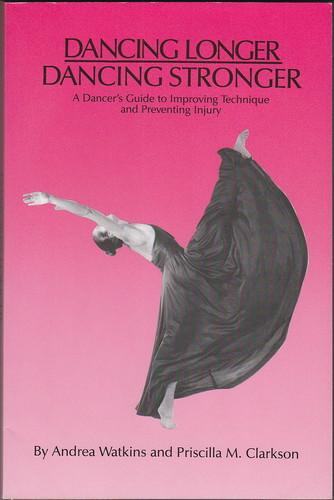
Title: Dancing Longer Dancing Stronger: A Dancer's Guide to Improving Technique and Preventing Injury
Author: Andrea Watkins and Priscilla M. Clarkson
Genre: Non-Fiction
Length: 296 Pages
Weight: 1.0 lbs
Date of Completion: May 28, 2013
Thoughts:
So...I'm not a ballet dancer. I'm not any kind of dancer. In all honesty, I can't actually dance. For the health and safety of those around me, I usually refrain from anything that resembles dancing. Why then did I, a bona fide non-dancer, purchase and read a self help book about improving ballet technique? Impulse. Curiosity. Jealousy. Take your pick; any of them work.
When I was younger, I was involved in gymnastics, soccer, and other activities. However, with four young and active children, my parents had neither the time nor the money to support us all in multiple pursuits. We were each given a choice: pick one. Following, as I always do, in my older brother's footsteps, I chose soccer. Thus, for the remainder of my youth and life as an teen, and now as an adult, there are moments when I question that decision.
I never went to ballet classes and learned to be flexible and graceful. I stuffed dirty shin guards and soccer cleats into a bag and played roughshod with the boys. It has taken me years to shake off much of the tomboy shadow. Don't get me wrong, it is who I am and I don't regret the time I spent in soccer. I miss it a lot these days. What I do regret was the complete lack of femininity and grace in my development. I relate this to dance.
More often than not, this nostalgia follows a performance (modern dance, ballet, etc.) that I have attended. I always leave with this insane jealousy eating me up that I never got the chance to try that. The twirling, the jumping, the beautiful, sweeping movement. It is completely ridiculous of course, but I can't help but think how different my life would have been if I had chosen dance instead. For a while, I nearly decided to take adult ballet classes. Thankfully, common sense returned and reminded me that I have NO dance background at all and that attending something like that would simply be humiliating.
I've accepted that I will never be a ballet dancer, but that doesn't mean that I can't be more flexible and graceful. This book goes over basic muscular and bone anatomy, which means I read it with a highlighter and colored pencils. Some habits never go away. I also suffer from terrible IT band issues, and thought there might be information in the book about knee and hip alignment exercises. Turns out, I was right. Though not as detailed as anything in a class would be, the exercises are simple and are meant to be done at home in a private workout session. This is ideal for my situation. I've added it into my morning routine stuff, so I guess we will see what happens.
Good Omens by Neil Gaiman and Terry Pratchett

Title: Good Omens
Author: Neil Gaiman and Terry Pratchett
Genre: Fantasy
Length: 432 Pages
Weight: 0.5 lbs
Date of Completion: May 25, 2013
Thoughts:
I cannot ever find the words to adequately describe Neil Gaiman's work. Witty, sharp, and classic cover most of the basics, but they never seem to convey the vastness of it. I don't remember the last time I laughed out loud this much while reading a book. Intelligent humor is a welcome relief and quite refreshing. Though I've never really gotten into the Discworld series by Pratchett (more due to time constraints and a 4,000 book long to-read list than any dislike of his works), I can appreciate his talent simply from the praise he receives from my peers. As a fan of Douglas Adams, it was easy to get caught up in this world when I first read it, and even more so now that I've come back to it as a favorite.
The British have mastered the art of a dry, scathing, intelligent wit. It is clever satire and entertaining parody; if you don't have the mindset that God can take a joke, this book is not for you. Part of this sharp humor is the ability to laugh at our own religious perspectives and have a sense of humor. Gaiman and Pratchett take a swift kick at the sacrosanct and absurd alike, and don't bother to differentiate the two either. Their irreverent humor makes this book the most enjoyable form of blasphemy I've found in a long time.
This book has everything that is missing from popular literature these days--and nearly as absent from American pop culture. I could go on for quite a while and bemoan the lack of intelligence and cleverness in modern society (specifically the American), but that would mar the tone of this happy post. Suffice it to say that I have far too much European blood to take kindly to the common ignorance.
I thought it appropriate to finish this book on Towel Day, though I would have liked to have done so earlier. So much for a summer full of free time for reading once I graduated. As Neverwhere is also in the pile of books by my bed, it looks like the Neil Gaiman party will continue.
Saturday, May 11, 2013
Earth Unaware by Orson Scott Card and Aaron Johnston
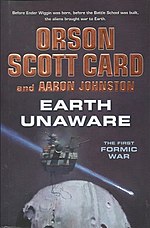
Title: Earth Unaware
Author: Orson Scott Card and Aaron Johnston
Genre: Science Fiction
Length: 464 Pages
Weight: 0.5 lbs
Date of Completion: May 11, 2013
Thoughts:
It is official official at this point: I am a college graduate. Now what am I supposed to do with myself? Personally, I think I should just bury myself for days at a time with a book and ignore the rest of humanity. I'm good at that. Didn't get as much of that done this week as I would have liked, but work is stupid and decided to change our certifications. Nothing says "I'm in the process of training my replacement so I can quit" quite like spending time and money to get a certification I'm not going to need in two months.
At a recent jaunt in Barnes and Noble (as I obviously have no self control), I noticed a new Orson Scott Card book. Naturally, I freaked out and it was added to my stack of books. An unexpected purchase, but a welcome surprise. While I know that this story, the history of the First and Second Formic Wars, which are the back story for Ender's Game, has already come out in the form of comics by Card and Johnston, I have to say that novels are always better. Except when it comes to Superman. I'm not a huge comics fan, but I do have all of the Command School comics from Ender's Game. It is one of the few sets I acquired for myself.
Back to this book. It is another 24 hour read, not because it is short or lacking in depth. I read it all day at work. Probably ignored my staff a little bit but hey....I hate working Saturdays. They always go wrong and put me in a terrible mood. At any rate, I found I was unable to put the book down. I liked how Card, who has had this world in his head since the late 70s (conservatively) when Ender's Game was initially released as a novella, has been able to release the entire back story and history of the world in the pre-Formic era. We start Ender's story with a society that already knows it is not alone in the universe. They pulled all of the Formic technology, and it has been incorporated into the lives of all the characters. In this book, however, we see the technological development of mankind, as well as the beginnings of change that come to the government and social structures when you begin to spread beyond the surface of the planet.
Here, the process starts of unifying the world from a series of countries and factions to a singular body of humanity. This will initially be completed by Peter Wiggin as the Hedgemon, and that is a book (the Hive and the Hedgemon) that I would love to have Card write. I think it is interesting how it is an attack that challenges humanity, not a portion of it or a specific group but everyone who can call Earth home, to unite countries and ethnicities. Sadly, I think this is the only way that it would happen in real life. Look at what that type of tragedy does. Think back to 9/11 and, more recently, Boston. Those terrible attacks, which not only killed and injured many, also brought people together. It gave them a cause to rally behind and reinforced the ties of their communities. This is exactly what I believe we will see with the Bugger invasions.
We are also introduced to Mazer Rackham. Back in Ender's Game, we meet Rackham as he trains Ender to be a commander. Card gives us a little information, but it is implied that the man who was responsible(?) for ending the Formic Wars and was kept alive through space flight until they found their next Captain was pretty damn important. Though there was just a very, and I mean very basic introduction of the life that would build Rackham. Mostly, it was an interesting side story of military operations. When they do start on Mazer, that is something I look forward to in the next book(s).
It was fun to see more with Aaron Johnston, who also worked with Card on Invasive Procedures (which I also have). They seem to work very well together and I can't wait to see how they put this whole universe together. I've been careful to stay away from spoilers, as I hope there are several friends who will read this book, but I did love the snide digs that Card made towards what can only be that universe's version of Youtube trolls. Hilarious! This book was already out in mass market paperback by the time I found it, so I am lucky enough to know that the next book comes out in July. It better be before I leave!
Sunday, April 28, 2013
A Wizard of Earthsea by Ursula K. LeGuin

Title: A Wizard of Earthsea
Author: Ursula K. LeGuin
Genre: Fantasy
Length: 264 Pages
Weight: 0.5 lbs
Date of Completion: April 28, 2013
Thoughts:
I haven't been able to read much since getting back from that wonderful trip for spring break. Graduating college is no easy feat, but these classes have seemed hell-bent on sucking the soul out of my life. Sadly, this semester is not as bad as the last, but I have less and less willpower to do anything. Talk about a major burnout. However, I will be officially done with both of my undergraduate degrees in 5 days. Then I can read to my heart's content.
For Easter, I got a gift certificate to Barnes and Noble (my parents know me so well) and I was able to practice some measure of self control by not spending it all immediately. Last week, however, I treated myself to a trip to the bookstore after finishing my last midterm and homework assignments. I came home with several more Shakespearean plays to nearly complete that library, as well as an Ursula LeGuin book that caught my eye. The Earthsea series was recommended to me by several of my book aficionado friends, and I decided to give it a try while carousing the SF/Fantasy section.
This was definitely a great choice. Though the Earthsea series is labeled as a young adult (since when has that ever stopped me?), it was more than enough to get me hooked on LeGuin. I'd like to make it through this series, which shouldn't take long. I read this entire book in one day. Granted, I didn't do much else besides church and read, but that makes for a wonderful day. There is just an elegance about the way she writes; it actually reminds me a lot of H.G. Wells with the imagination of Garth Nix. I am immediately moving The Dispossessed up on my To Read list.
For this story in particular, I was just relieved to be able to sink into a fantasy world again. While I can contribute the feeling partially to my stress level and anxiety with a life full of constant change and unknown (an absolute horror for someone like me who plans everything out far in advance), I felt such a strange connection with Ged. Through the entire story, I felt his character was so burdened with the weight of this terrible shadow. It is certainly a great metaphor for my life. The great thing about this? Fairy tales were not meant to teach us that monsters exist. We already know this. These stories are meant to tell us that monsters can be slain. I might not be fighting any monsters, this certainly gives me courage to soldier on.
Wednesday, March 20, 2013
King Lear by William Shakespeare

Title: King Lear
Author: William Shakespeare
Genre: Tragedy
Length: 384 Pages
Weight: 0.9 lbs
Date of Completion: March 17, 2013
Thoughts:
William, William, William. In my opinion, Shakespeare has no equal. His understanding of human nature and his ability to bring it life, both in the pages of his work and on stage, is unparalleled. When I decided on this challenge, I made a short list of books I wanted to make sure I completed. The entire collected works of Shakespeare was very near the top. So, while I have been working my way through the unread stack of books by my bed, I had to sneak in one by Will. I have so much of my soul in his books, that I feel almost a personal connection with him, so much so that I will refer to him in an overly friendly manner, and call him Will. I wish more people could write with the grace, ease, and wit that is found in Shakespeare's books.
Reading King Lear brought back so many memories, but more importantly it reignited my indignation at living in such an uncultured society where I cannot go see any of his works performed at any time other than the Shakespeare Festival in the fall. It is at times like this that I wish I lived in a city with a more active theater community. I'm a huge fan, but there aren't too many shows.
That short rant aside, I pulled out King Lear at random off of the shelf in a hurry while I was packing my bags. So, while I was sitting by the pool, enjoying some sun (and more importantly HEAT) for the fist time in months, imagine my surprise to find I had picked one of the books I had read and annotated way back in high school. I have several versions of different works, including a fancy, leather-bound edition, but I like the Folger library version the best. I'll be the first to admit that I like Sparknotes while I;'m reading. There are people much more intelligent and knowledgeable than I am who can expound and clarify where my understanding may fall short. I will take any assistance to receive greater enjoyment while reading.
Whenever I read Shakespeare I am drawn back to my favorite scenes, soliloquies or images. In this book, my favorite scene is Lear's decent into madness as he wanders amidts a terrible storm. Particularly, I love the echo of unhinged destruction in the weather. I can imagine one of those dark and stormy nights with wind that skins your face and hands raw whipping sleets of rain against you. Thunder crashing as lightning etches across the sky, the only light as Lear crawls away from his cruel family and the remnants of his sanity. This continues onto the tribunal of Goneril and Regan in a cave. While Edgar and Lear egg each other on in their madness, you can almost forget that Edgar is only acting. He presents a convincing loon that fools his own father.
This madness is my favorite part of the story. I think Will does such an incredible job of showing how a certain sort of clarity often accompanies madness. It can be like losing your filter, where the simple truth can hold the greatest wisdom. Gloucester only sees the truth once his eyes have been put out. There is a tragic and poignant beauty in the scene where Edgar, disguised as a madmen leads his now blinded father to his suicide "at the top of the cliffs of Dover."
With a wonderful insight into the human psyche, I think King Lear does a great treatment of old age. It is both terrible and fascinating. Of greater terror is the function of Regan and Goneril. As they sin against nature to plot the death of their father (and each other), Will portrays them as the ultimate evil. Afterall, Cornwall only puts our Gloucester's eyes after Goneril suggests it. That is also something I noticed while reading this. The tragedies of Shakespeare are incredibly violent, as well as deadly. You don't exactly get this when all you read is stage directions that say his eye was forced out. In a play, you can a get a better image of this grisly scene, but even so-that would be a terrible and bloody reality.
On a happier note, I want to talk about my favorite characters, the Fool and Kent. The Fool is wise and honest, a perfect foil to the foolish actions of Lear. His position allows him the freedom to speak frankly with the King, even if it does no good. As for Kent, his loyalty is the greatest attribute a friend can have. We all have that friend who is kind and loyal no matter what we do, the friend that we never deserve. That is Kent, and I think Lear is never thankful enough.
The Mabinogion translated by Jeffrey Gantz

Title: The Mabinogion
Author: Unknown, but translated by Jeffery Gantz
Genre: Fantasy-Fairy Tale
Length: 320 Pages
Weight: 0.6 lbs
Date of Completion: March 15, 2013
Thoughts:
This book was suggested to me by my Amazon book account. Obviously, I buy an absurdly large amount of books online through them, so whatever algorithm system tracks my account knows my taste in books fairly well. The combination of Welsh/British culture that I love so much mingled with fairy tales was a perfect match--Medieval Welsh prose tales that contain a twist of the ancient but a common theme instantly recognizable. Add in a pleasant bit of Arthurian escapades and you have a winner. I really enjoyed this book and it was a fairly quick read (I have to excuse myself on the time it took to read it as I tried to get into a book in the middle of mid-terms right before spring break. Bad idea.) I have so many thoughts about reading this books, but I will try to organize them into some sort of coherent stream.
My first, and overarching thought is that I wish I had read this book in an English Lit class. With few notable exceptions, I have always enjoyed literature classes. Not only because I love to read, but also for the opportunity it gave for in depth discussion and analysis. Those classes helped to build a foundation of thought on which I could pursue literature with a higher degree of skill and comprehension. Thankfully, this book has a long forward to the body of the work that explains much of the historical context and importance of the branches of the work.
There are still so many things that were unclear; why were certain stories included? The context of several plot layouts and much of the symbolism was lost. While the cultural content of most of the stories was understandable in the context of the story line, they were filled with completely foreign concepts. I didn't find a Sparknotes for the book (Yes, I use Sparknotes for books I read for pleasure), so I wish that I had access to more than just an internet search. English professors, especially those who have a specialization in a topic you are particularly interested in, are a veritable wellspring of information.
My next thought sort of stems from the above topic. There were several things that I found strange when reading this. In one of the branches (stories), the brothers-in-law of the antagonist were given his conquering armies to wreck havoc wherever they pleased as a reward for their assistance. When they were finished killing and rampaging, they and their men came home with all of the loot (money and women). To keep the women from contaminating their language with their foreign words and accents, they cut out their tongues. And this was all written with the same jovial tone as the rest of the story. I can understand that the traits of conquering and domination through quests was a large part of proving one's worth as a man, but the tongue thing caught me off guard. It was just thrown in at the end of the story and I had to re-read the passage several times to make sure that I wasn't mistaken in my understanding. Apparently this barbaric act of permanent silence is acceptable, even commonplace in the ancient world. Maybe this is just a Welsh thing.
Speaking of Wales, I am supremely grateful that Mr. Gantz translated the Mabinogi into English. At the beginning of the book, there is a pronunciation chart to help with all of the Welsh names. Now, I have ancestry in Wales and a lot of experience with foreign cultures and languages, but I could not decipher how to say most of the character's names. For the most part, I had to resort to the simple and childish method of simply associating the organization of letters to a person without any effort to make sense of them. This was highly effective, and only became difficult when several characters had similar names, or when a character re-appeared in another story. Even with the pronunciation guide, I'm still hopeless. At the very least though, this was a minor inconvenience; it didn't detract from the stories at all.
Examples:
Pwyll, Prince of Dyved
Manawydan
Penn llwyn on Bwya
Annwvyn
Arllechwedd
In conclusion, I'm a big fan of fairy tales, both original and retold. It is always interesting to see how our modern versions differ from the original forms. I have so many comments about the strange characters and stories, but I think I'll have to end this post with one last thought. This book was a lot of fun, and I think it is extremely unique and undervalued. If you can get your hands on this edition (don't go with Guest's), it is well worth the time to read.
Subscribe to:
Comments (Atom)